Refrigerant Charge Verification
An air conditioner or heat pump with the wrong refrigerant charge can lose a big share of its rated efficiency, shorten equipment life and cause compressor failure. Refrigerant charge verification confirms the system has the right amount — either by watching it get weighed in, or by measuring how the system runs.
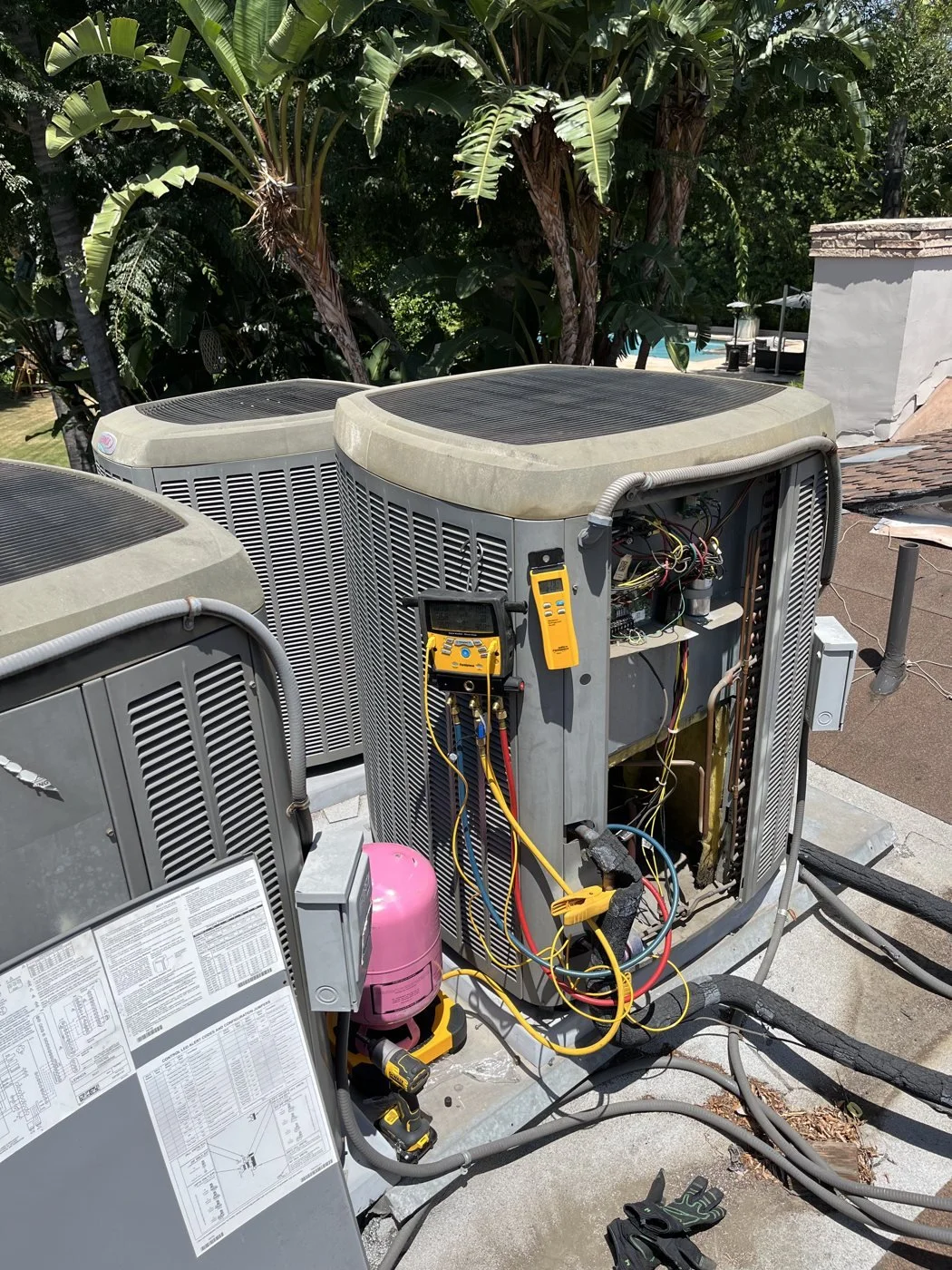
Which method applies
The method depends on the equipment — not on what’s most convenient on test day.
Witnessed weigh-in
The HERS/ECC Rater has to be physically present at install to watch the vacuum, the decay test and the weigh-in. It can’t be done remotely or after the fact.
Subcooling
The normal method for conventional split systems. Measured with the system running at steady state and compared to the manufacturer’s target subcooling.
Superheat
Only for systems with a fixed metering device — rarely seen in the field today.
What to expect
How we handle refrigerant charge verification when you hire us.
We’re there for the weigh-in
Mini-split installations require an in-person refrigerant weigh-in — something that catches a lot of homeowners and contractors off guard. We coordinate with your HVAC contractor and are on site when the system is charged. Calling after the install is one of the most common compliance failures: if the witnessed weigh-in is missed, the refrigerant has to be fully recovered before the charge can be verified.
- Factory charge (lbs/oz) — from the equipment nameplate
- Factory line set length — the length the factory charge is designed for
- Actual installed line set length — measured, not estimated
- Liquid line diameter
- Charge correction rate (oz/ft) — from the manufacturer’s installation manual
- Calculated charge adjustment for the installed line set
Subcooling on a running system
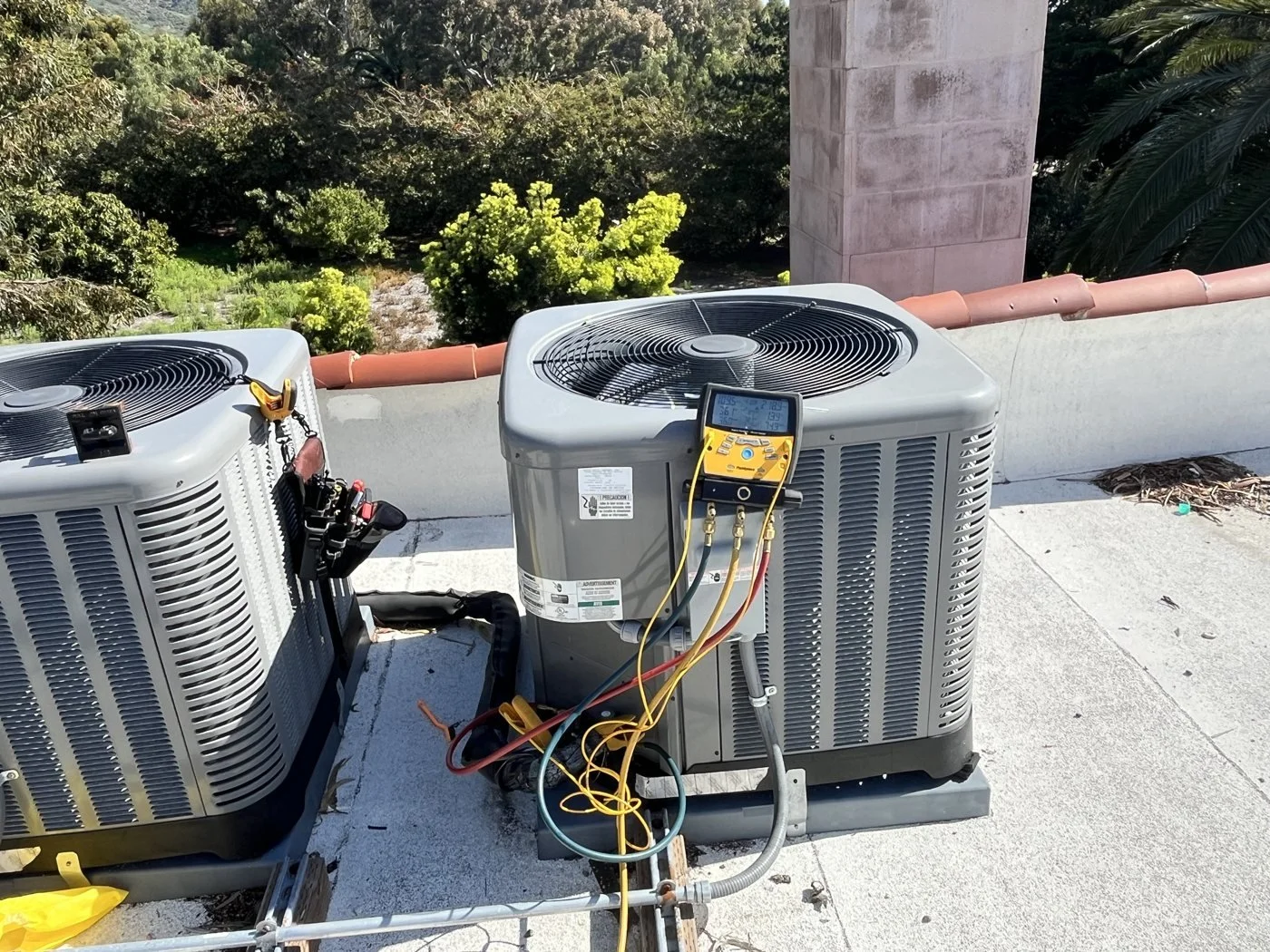
For ducted split systems with a TXV or EXV, we verify the charge by subcooling once the system is installed, charged and running. If you don’t already have a HERS/ECC Rater lined up, call us before the equipment goes in — not after.
When it’s required
Your CF1R (or CF2R for prescriptive alterations) governs what applies to your project.
| Project | Air conditioners | Heat pumps | Code |
|---|---|---|---|
| 2025 code — permits on or after Jan. 1, 2026: new construction, or refrigerant components installed/replaced in an alteration | Climate Zones 2, 8–15 | All climate zones | 2025 Table 150.1-A · §150.2(b)1Fii |
| 2022 code — permits before Jan. 1, 2026: new construction when shown on the CF1R; alterations when refrigerant components are installed or replaced | Climate Zones 2, 8–15 | Climate Zones 2, 8–15 | §150.1(c)7A · §150.2(b)1F |
| Systems that can’t be verified by subcooling/superheat (e.g. mini-splits) | Witnessed weigh-in | §150.2(b)1Fiii | |
| Factory-charged packaged unit, new or complete replacement | Exempt from charge verification (installer certifies) | §150.2(b)1F | |
The code
Click a section to read the actual code language, or open it in the official CEC document.
§150.1(c)7ANew construction: refrigerant charge
c. The installer shall charge the system according to manufacturer’s specifications. Refrigerant charge shall be verified according to one of the following options, as applicable: I. The installer and rater shall perform the standard charge procedure as specified by Reference Residential Appendix Section RA3.2.2… III. The installer shall perform the weigh-in charging procedure as specified by Reference Residential Appendix Section RA3.2.3.1…
§150.2(b)1FAlterations: refrigerant components replaced
ii. In Climate Zones 2, 8, 9, 10, 11, 12, 13, 14 and 15, air-cooled air conditioners and air-source heat pumps, including but not limited to ducted split systems, ducted package systems, small duct high velocity air systems, and minisplit systems, shall comply…
Exception: Entirely new or complete replacement packaged systems for which the manufacturer has verified correct system refrigerant charge prior to shipment from the factory are not required to have refrigerant charge confirmed through field verification and diagnostic testing.
§150.2(b)1FiiiSystems that require a witnessed weigh-in
a. The installer shall confirm the refrigerant charge using the weigh-in charging procedure specified in Reference Residential Appendix Section RA3.2.3.1, as verified by a [HERS/ECC] Rater according to the procedures specified in Reference Residential Appendix RA3.2.3.2.
RA3.2.2Standard charge verification (subcooling / superheat)
Rater criteria (Table RA3.2-1): subcooling within ±6°F of the manufacturer’s target, outdoor air 55–120°F, return air ≥70°F dry-bulb; superheat within ±8°F of target, outdoor air 55–115°F.
RA3.2.3.2[HERS/ECC] Rater observation of weigh-in
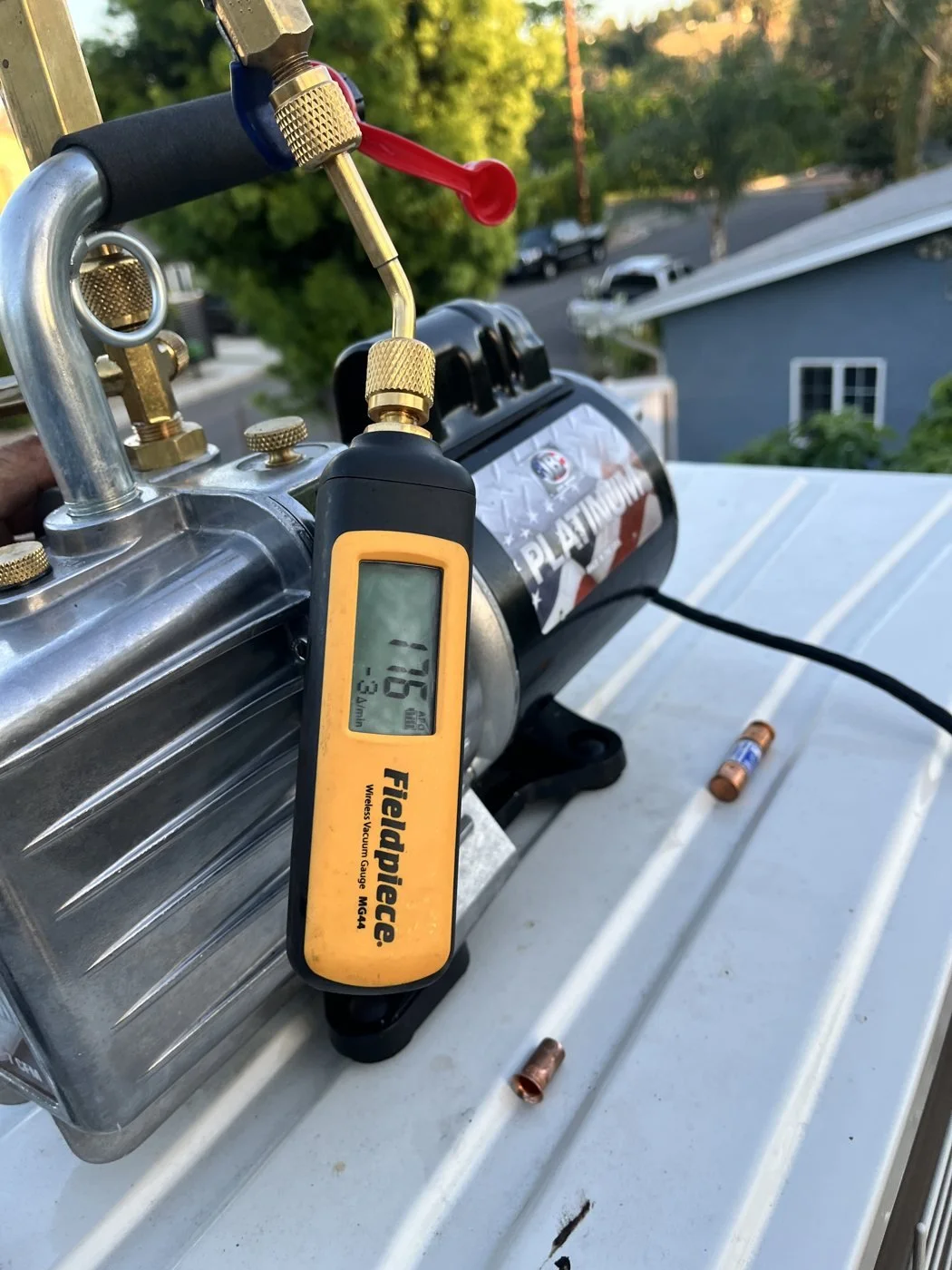
(a) The system is evacuated to 500 microns or less and, when isolated, rises no more than 300 microns over five minutes.
(b) The lineset correction is calculated based on the length and diameter of the lineset, including the liquid line filter drier if required per outdoor condensing unit manufacturer instructions.
(c) The indoor coil correction to refrigerant weight is used if it is supplied by the manufacturer.
(d) The installer adds or removes the amount of charge calculated for the lineset correction or installs the total charge based on lineset, indoor coil, and standard label charge.
Common failures & how to avoid them
What actually goes wrong — and how to avoid it.
- Calling after the install. If the evacuation, decay test and weigh-in aren’t witnessed in person, the only compliant path is to recover all of the refrigerant — including the compressor — re-evacuate, and recharge from zero with the rater present. It’s costly, and on a new inverter system it can actually damage the equipment. We don’t recommend it. See our blog on this issue →
- Refrigerant added without the rater present when a witnessed weigh-in is required.
- Vacuum and decay test skipped or not held before charging.
- Line set length estimated instead of measured, so the charge correction is wrong.
- Schedule the HERS/ECC Rater before charging — the rater must be on site for the weigh-in.
- Evacuate to 500 microns or less, isolate, and confirm the rise is 300 microns or less over 5 minutes before charging.
- Measure the installed line set and have the manufacturer’s charge correction rate ready.
- Confirm the equipment matches the CF1R before it’s installed.
Installing a mini-split or heat pump?
Book the weigh-in before the system is charged.